"Sailboat Refugees Arrive" from Life Magazine, 1946

That time my great-great uncle was an illegal immigrant and the West actually responded quite well. (Eventually.)

I’m going to cheat at blogging today and tell a story that isn’t new, and that didn’t actually happen to me, but it’s a good story and it’s a true story and I think you’ll find it interesting. So come gather round and Aunty Zoe will tell you a tale…

Our story starts in 1946, in Sweden, where there were two Estonian brothers, having an argument. We don’t know what exactly they were arguing about, but tradition tells us that it went something like:
“We should get out of Europe, before it all falls to the Soviets.”
“Agreed!”
“I know, I’ll sail this 38-foot sloop to America. Come with me!”
“You have got to be joking, there is no way I’m going to try and cross the Atlantic in that. Are you crazy? You’re a small-time fisherman in the Gulf of Finland, not a sea captain.”

And the (perhaps more safety-minded) brother ended up taking his family to Australia, in, you know, a real ship. His daughters live there to this day; one of them is my Oma.

As for the crazy brother… Well, until a few years ago the family of the brother who went to Australia only knew vaguely what had happened — that his boat had arrived and his family had settled in the US. But with so many newspaper archives online, it occured to one of them (full credit: my Mum) to have a look and see if anything had been written, maybe in the local newspaper of the city they’d ended up in.

In fact, the story didn’t even need searching in small-town newspaper archives, it appeard in Life magazine, September 23, 1946, an article about a subsequent boatload of refugees. Here we find the dramatic twist that the Estonian boats and their passengers had been denied entry to the US and were “in custody of immigration authorities pending further study.”

You see, these “refugees from Russian political domination” (as Life put it) did not have anywhere near the right documentation to migrate to the US. There was some back-and-forth, which can be summarized mostly as:
Estonians: We’re fleeing the USSR because we agree with you that it’s bad!
American authorities: But we didn’t mean for you to actually do that.
The situation also stirred up public opinion, including one Louise Hurlbutt de Wetter who wrote to the New York Times on September 14, 1946 (subscription required):

“I think there are times when orderly processes have to be dispensed with, and each group judged on its merits and its probable contributions as citizens of our country rather than what they posses in the form of offical documents.
[…] We surely can afford to be more generous and less strangled by red tape. Our country would not be the loser in admitting a group of human beings who have proved their courage and caliber in such a forceful manner.”

After a couple of months, the government accepted the appeal and visas were granted. Cynical me realizes they were well aware of the PR opportunities of accepting refugees from the USSR, but we’ll close the story instead with this rousing extract from an editorial in the New York Times (November 4, 1946, subscription required):

A Victory For Courage

The forty-eight Estonian refugees who wanted so much to live in a free country that they crossed the Atlantic last August and September in three tiny boats can breathe easily today. By Presidential Order they are not to be deported. Like some earlier refugees who crossed in a ship called the Mayflower, they can settle down, become citizens and grow up with the country. No one who admires courage and determination would have been satisfied if President Truman had decided otherwise.

[…] The human impulse can sometimes admirably replace the strict letter of the law. We can be happy that it has done so in this case, and we can confidently expect that this country will be enriched, so long as this Estonian strain holds out, by these adventurous arrivals.

And that, kids, is the story of how my great-great uncle was an illegal immigrant — a boat person, even — and yet somehow didn’t destroy the foundations or prosperity of the West and was even welcomed by the editors of a major newspaper.

Photo credit: Life magazine.

Edit to add: I only had a copy of the text I quoted here, I don’t actually have a NYT subscription, but rumour has it that the final quote was actually a quote from President Truman in a news article, not an editorial. If anyone has a subscription and wants to check that, I’d be happy to make a correction if needed.

Got any good recipes with no onions or garlic? Or: What it’s like to have a wacky sense of smell.

African elephant warning raised trunk.jpg

(True confessions: I had to check on wikipedia that elephants actually use their trunks as noses and that’s not just something we pretend when we talk to small children.) African elephant warning raised trunk” by Muhammad Mahdi Karim Facebook

If you’ve been following along for a while, you might remember that back in April I realised I couldn’t smell anything. Not in the sense of, Yup, I’m living in a clean (enough) apartment without any unpleasant odours, but in the sense of smelling nothing. A sort of silence for the nose. The realization came as something of surprise for me, since a working sense of smell is something you tend to take for granted, but apparently losing your sense of smell is a thing that can happen when you injure your head, which I had done a few weeks prior.

(As an aside, there’s an extremely nerdy drinking game to be had by looking through neuroscience journals and taking a shot whenever you encounter a variation on “olfactory disorders are among the most common sequelae of head injuries” in the introduction to a paper. As an aside to an aside: how cool is sequelae as a word?) Continue reading

Gran Madre and Superga at night

The other four seasons of the year.

It is currently pouring with rain and I’m wearing jeans and a cardigan, and I’m starting to lose faith in the traditional weather-based seasons here in Turin. (At least we had a summer here this year, unlike last year!) So I want to propse a new set of seasons, that aren’t about the weather. They’re the Living Abroad Seasons. There’s four of them, so that’s nice and traditional, although up-front disclaimer: they’re not equal in length, which jars against my need for symmetry, but oh well.

The current season is August, aka, Nothing Is Happening Here, Get Out of Town Season. Turin’s one of those Italian cities where everyone clears off to the mountains and/or the seaside for as much of August as possible. Shops close, there’s no traffic even in peak hour, the mailboxes in my apartment are piling up with uncollected letters. Normally I’d also be out of town for mid-August, but this year I somehow managed to arrange things so I arrived back in Turin on the 15th. Ghost town. It’s peaceful, in a way.

And August is a good break to psych up for People Arriving Season in September/October. People come back from holidays, either tanned (if they’re Italian) or sunburnt (if they’re like me). The university year starts, as do many fixed-term jobs, and new people arrive in town. I am every stereotype of an introvert, but I love meeting new people. (I just need a lie down in a dark room afterwards.) Finding out where people are from, why they’re here, noticing shared interests, it’s all great. People Arriving Season is my favourite Living Abroad Season.

The next season is the Long Season. Work. Socialize, in a more normal way now that not everyone is a new face. Slog through winter. Daydream of summer holidays. Christmas, New Years. Maybe travel somewhere fun over the Easter weekend. Become closer friends with people. Drift apart from others. Once the novelty of living away from where you grew up wears off, this is the season that looks like “real life”.

And then we get to Goodbye Season, in June-July. The university year ends, and so do those fixed-contract jobs, and over the course of a few weeks easily half of the new friends you made in September will have moved on to new things. It’s an exciting time, because people are going to do all sorts of interesting things and you get to be happy for them. But because I sort of snuck out of Perth when I left, I never really did the goodbye thing there (sorry everyone!) and I was in no way prepared for how exhausting Goodbye Season would be until I experienced it for myself. Constantly thinking, “will I ever see them again, I wonder?” is a bit of a downer, it turns out.

Sometimes I daydream of moving everyone I know and love to the same city — or inventing teleportation — so that I can keep all my friends nearby. And of course I could settle down somewhere and have a stable group of friends that I see every week for years and years. I know people who have based their lives around stability and it’s suiting them splendidly. But I suspect life isn’t as stable as it sometimes looks, and for now I’ll choose the highs and lows of instability.

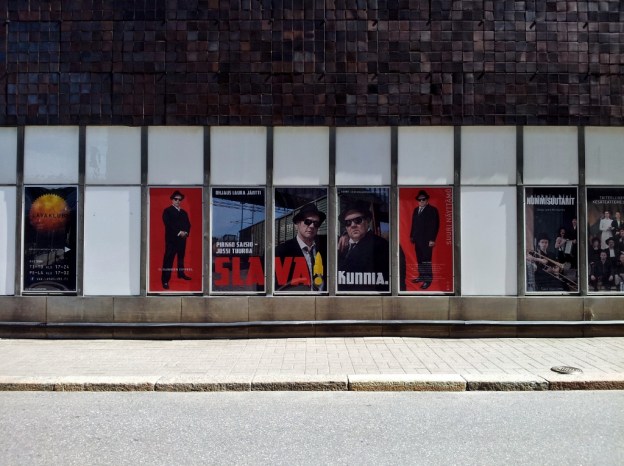
Theatre posters in Helsinki

How to spend an afternoon in Helsinki.

Subtitle: on the cheap.

Subtitle 2: assuming it’s sunny. If it’s rainy/cold/snowy, you’re on your own.

  1. Go to the train station. Admire the late Art Nouveau-early Art Deco architecture and the way it manages to be solid, with its granite exterior and heavy doors against the winter cold, but also elegant. Meander past the platforms and note how the long distance departures board lists St Petersburg as a destination. Realise you wish you were about to board a train to St Petersburg, then on to Moscow, then across Siberia, then then then…
    20150725_132809 (480x640)
  2. But you have a commitment to be at the office on Monday and don’t even have a Russian visa, so walk past the ticket office and head to the open air markets in Hakaniemi instead. Buy a punnet of strawberries from a stall with Marimekko fabrics hung over the tent walls as decoration. Wander around the market hall. If you were staying closer, you’d buy fresh fish and tea and rye bread. Instead, buy a postcard from a stall upstairs.
  3. Your strawberries need eating before they get squashed in your bag. Find a spot to sit in Kaisaniemi botanical gardens. Watch people go by — young couples enjoying the sunshine, groups of teenagers, parents walking with their small children scooting on balance bikes. Try to remember if you have see any children in this city who aren’t blonde. (You have, it’s just confirmation bias you’re experiencing.)
    20150725_135925 (640x479)
  4. Wander to the waterfront and sit there for a while. It’s mid-afternoon and the sun is out and those plans you had this morning of taking yourself on a self-guided architecture walk around the city are rapidly losing imminence in the face of blue skies, fresh air and the sea gently lapping against the harbour wall.
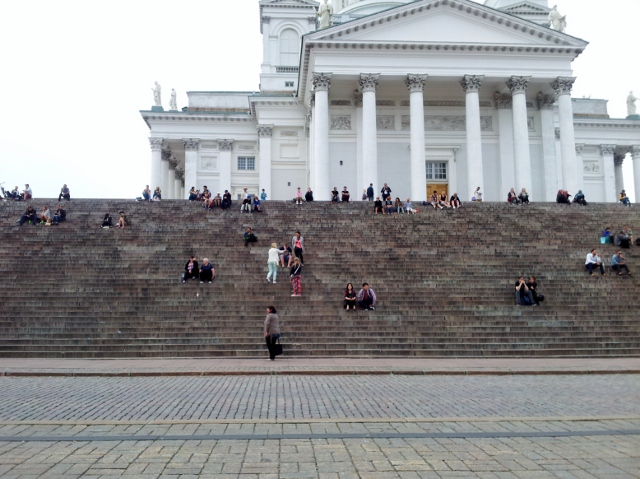
  5. Ok fine you probably should go and see something else in the city seeing as you have limited time here. Walk towards the main harbour. Admire the cathedral. Don’t go in, because there’s a wedding on and it’s closed to visitors. Admire the steps out the front, instead. Just like in Italy, the cathedral steps are a gathering place for tourists tired on their feet and teenagers looking for somewhere free to hang out, but unlike any cathedral steps you’ve seen in Italy, these are more like a staircase. Realize how steep they are are when you get vertigo trying to walk down them.
    They were really steep!
  6. Down at the harbour, feel vaguely smug for having gone to the Hakaniemi markets rather than the tourist markets. Have a look at the market hall, though, ostensibly to check out the architecture. While there, give into temptation and get a coffee and brownie at Story. Don’t think about how Finnish coffee-and-cake prices compare to the rest of the world, focus instead on how the brownie is dark and slightly spicy and very good.
  7. Walk up the hill to the park Kaivopuisto. Sit on a rocky outcrop and look down to the sea and the islands. Listen to the seagulls. Stay as long as you like.

Postscript: I never did see inside the cathedral — the middle of summer is wedding season, obviously! If you’re less interested in sitting in the sun and people watching than I am, you could always hop on the city ferry to Suomenlinna (5 euro each way) as a substitute for some of my sitting around. Also, that architecture walk I linked in point 4 looks good, even if I never got around to doing it because sitting in the sun was too nice.

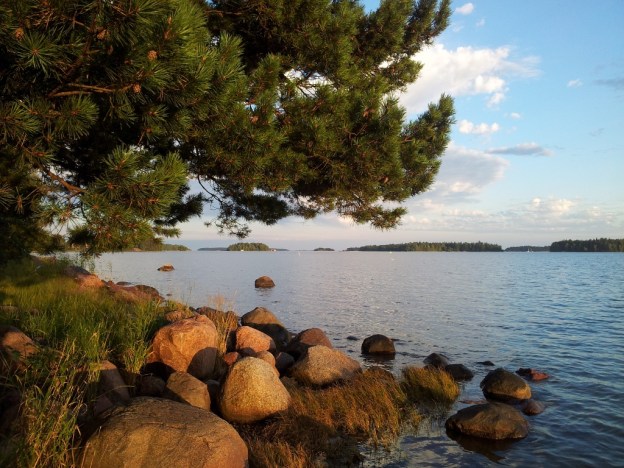
Shore near Espoo, Finland

Enjoying the evening light in Finland

July was a busy month for me, with a week-long work conference to kick the month off, then 3 separate friends visiting over the course of two weeks, before jumping on a plane for some more work travel. It was an exciting month, seeing people I hadn’t seen for months or even years, spending time in the south of Italy, being a tourist at home in Turin, trying to wrap my head around some new (to me) physics, lots of meals in restaurants and relatively few nights at home.

In contrast to all that, Finland has been trees and rocks and water and evening light. I’ve been here for two weeks now, for work, and every day I’ve had to remind myself that I’m not on holidays, and I really do need to go to the office. Partly it’s the feeling of quiet here that’s (paradoxically) distracting me — if you’re going to be productive, isn’t that synonymous with being busy?

I’m staying just outside of Helsinki proper, on the shores of an inlet surrounded by reeds. In the evenings I sometimes go for a walk on the gravel path through the birch trees, following the edge of the water. A couple of weeks ago on a grey Sunday afternoon, I followed the path all the way to the top of the inlet, where a herd of cows graze near the water. The trees muffled the sound of the nearby motorway and I felt like I’d left the city entirely.

Sometimes I walk in the other direction, down to the edge of the open sea, which is protected by islands and calm like a lake. There are always midges, and sometimes when the water is very still I can hear fishes jumping up to catch a midge that has ventured too close to the surface. I’ve never seen the fishes, only the ripples as they dive back down.

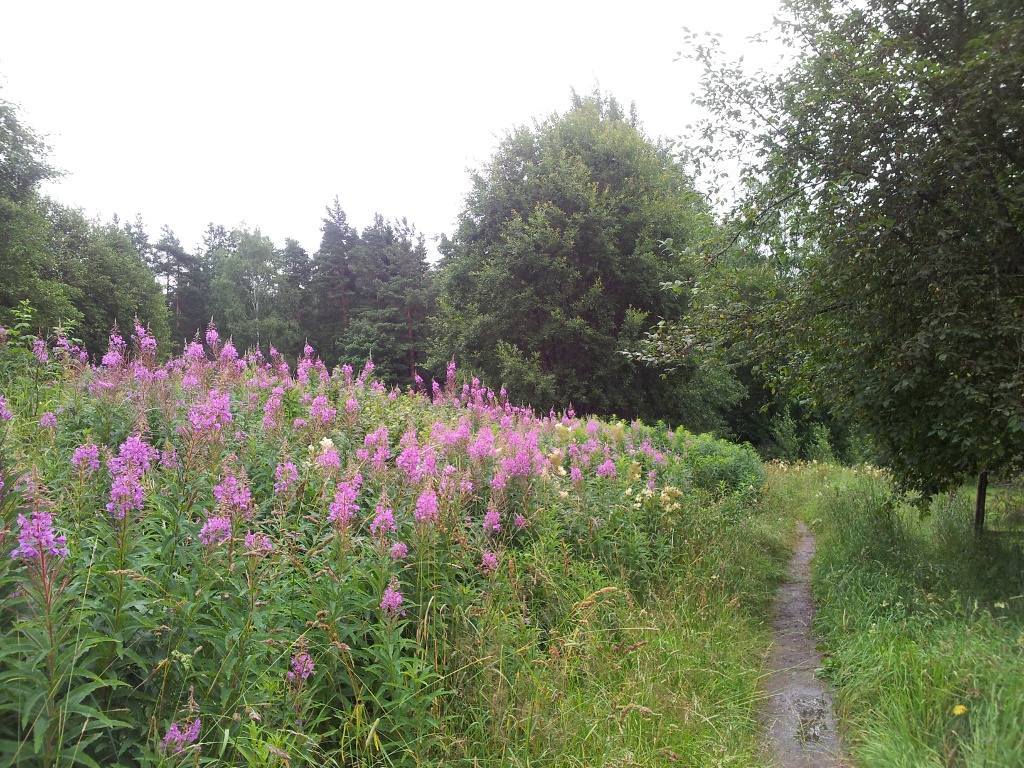
flowers

PS: If you think I have become a person at one with nature, I should also say I have spent many evenings using the fast internet in my accommodation to frantically skim-read blogs and news sites and videos. My latest game is “how cheap can I get a flight to Perth for Christmas, plus an interesting stopover on the way?” Question for readers — is it possible to have a nice time in Bali if you aren’t interested in drinking or surfing???

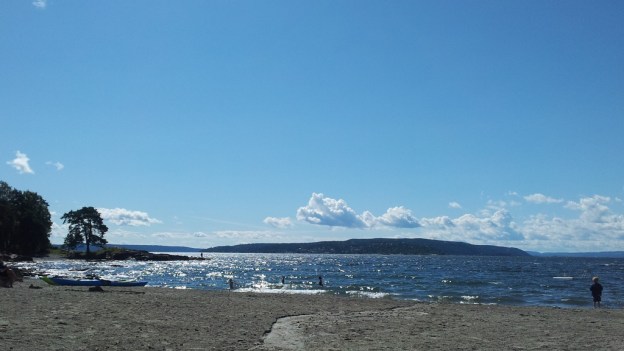
Beach near Oslo

Sun and sea… in Oslo, Norway

One of the first things H. said to me when I arrived in Oslo yesterday was “This is a perfect summer day, the kind we’re lucky to have here.” Oslo’s been having a mild, wet summer this year, but there was no sign of that when I got there yesterday morning. Blue skies, 20 degrees C (about 70 Fahrenheit), a slight breeze off the harbour. After a grey week in Helsinki, it was a welcome change. Continue reading

Beach in Gallipoli, Puglia

Gallipoli, Puglia. (No, not that Gallipoli. That one’s in Turkey.)

True confessions time: when people ask me if I’m travelling with someone else, I always say something vague and polite about “Oh I don’t know anyone on the same schedule as me” but what  I really mean is, “I love travelling alone and I’ve sort of forgotten how to travel with other people anyway.”

But travelling to Lecce and the surrounding region with B. was great fun. It helped that we had a logical division of labour — she has the history knowledge to make sense of the places we saw, I have enough Italian to translate informational plaques about them. Or this sign at an altar in the basilica at Gallipoli, clearly posted by someone who’s Had It With These Tourists:

IT IS ABSOLUTELY FORBIDDEN TO MOVE THE CANDLES, ESPECIALLY FOR TAKING PHOTOS

Continue reading

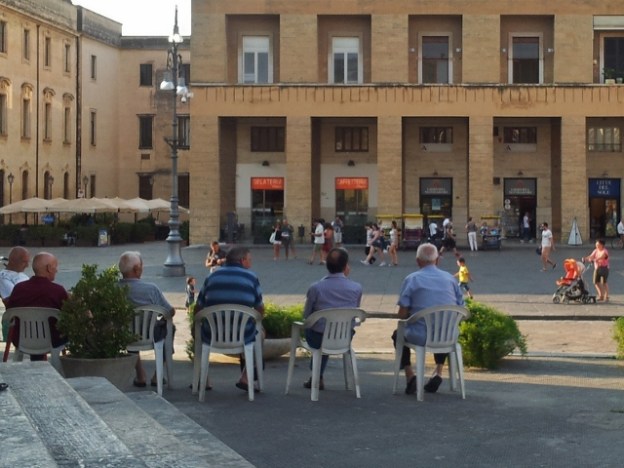
Old men on plastic chairs in Lecce, Puglia

A chat on a train ride across Italy.

An overnight train ride to Lecce, down in the heel of the boot of Italy, the diagonally opposite corner of Italy to Turin. Going to sleep in the south of Piemonte after watching the sun set over cornfields and rolling hills, waking up in Puglia. Red dirt, dry grass, ancient olive trees. “The light really is different here, isn’t it?” says the Pugliese woman we’re sharing a couchette with. She’s right. The sky is blue, blue like it is in Australia, and the light is clear.

Her husband, also in the couchette, is a gentleman, not letting me put my bag up in the rack myself even when I insist it’s not heavy. He tells us about how his whole family has been up in Turin for his son’s wedding. His nephew and the nephew’s wife are in the next carriage and they pop in for a chat. “What’s going on?” asks the conductor as he walks past this little gathering hanging around the door of the couchette. The nephew grins. “Oh, just a family reunion!”

As we roll through Puglia in the morning, we chat about the usual Italian things — food (we should definitely eat orecchiette), and history. The gentleman has studied archeology, and he tells us about all the influences that have gone into this corner of the world, not just the Romans and the Greeks but also the Carthaginians and the Normans and even some Germans. Later that week we’ll see in a museum some of the artifacts found from these powers but for now I can feel the sense of history rolling as invaders come and go.

At last we can see the sea, deep blue behind the rows of olives. We’re getting close to Lecce. “The sea so close makes the weather much nicer here than in Torino,” says the woman.
“Ugh, yes, it always stays hot in Torino, even at night…” I reply. “We’re from the coast, too, in Australia.”
“Australia! That’s a long way to travel.”
“I’d love to go to Australia,” adds her husband.
“Yes dear,” she says to him. She adds to us, laughing, “Listen to him, he wants to go to Australia. He won’t even take me to Venice!”


PS: It’s almost exactly a year ago I wrote a little blurb about cyclists in Turin and decided to stick it on a blog since it was a bit long for facebook. A post (roughly) per week later, and now my friends introduce me as, “This is Zoe, she has a blog” (?!) Thanks for reading, commenting, and generally encouraging this little project!

PPS: I love the guys in the photo for this post, clearly if the piazza doesn’t have enough seating the correct solution is to byo plastic chairs!

Pietro Micca: tunnels and heroes

According to TripAdvisor, the Museo Pietro Micca is the #11 thing to do in Turin. I saw that and thought, “Oh yeah, so what are things number 1 through 10?” but it turns out that #8 is “Spas” so I think we can safely ignore TripAdvisor’s rankings. At any rate, I think I’ve found my new favourite museum in town.

The entrance is a bland-looking 1960s building you’d easily walk past, and the museum dedicated to the French seige of Turin in 1706, which sounds like a fairly specialized local history topic. But this seige involved clever engineering of underground tunnels, which were lost until building works in the 1950s uncovered them. Most of the network of tunnels is now uncovered, and a visit to the museum includes a tour of part of it.

Towards the end of the tour -- of course, as soon as we got out of the museum we had to go look for where this was at street level

Towards the end of the tour — of course, as soon as we got out of the museum we had to go look for where this corresponded to at street level

Continue reading

Lake Como at sunset

Hiding under the airconditioning at Lake Como

It is hotttttt in most of Europe right now, and northern Italy is no exception. I spent the past week in Como, at a fantastic conference, but based on the following I think I need to up my hot weather game…

  1. I muttered several times over the week “It’s hot in the worm, Bernard”, which, a) no-one here gets the reference and b) it’s not even from the summer episode of Black Books.
  2. Last weekend, before I left Turin, I spent a hot and humid morning bussing out to Grugliasco to buy some bathers at Decathlon, the sports & outdoors superstore. My reasoning for going so far afield was sound enough: there might be a chance of swimming during a week next to a lake, and I wanted bathers that were sporty rather than string-based. Except the selection of bathers at Decathlon was only marginally less infuriating than at every other store in Torino. And I spent the whole week in Como itself, where the water is un-swimmably murky with duck poo.
  3. Actually, I spent the whole week in Como itself… except for a quick trip one evening over to Lugano, where there is a small swimming beach in the city park on the lake. I did not take my bathers.
  4. From my hotel to the conference venue was a 20 minute walk along the lake front. Lovely views, historical villas, just what you want to wake yourself up in the morning before a day of sitting listening to talks. Clearly the one thing I need to add to this was a heavy backpack with my ridiculous work laptop — the specs are amazing but the power adapter alone weighs as much as some laptops. What did I use all this computing power for? Most days, it stayed in my bag.
  5. Smart things to pack for a week of hot weather: a sun hat, light-weight shirts in pale colours, a decent sized water bottle. Things I packed: none of the above, and a pair of trousers and a cardigan I never wore.
  6. There are good drinks for drinking out on a piazza on a summer evening, like beer and spritz. Or, you could drink negronis and get up from bed every 3 hours to pee from the alcohol.
  7. One thing I did right: slept with the aircon on in my hotel room on Thursday night. Not strictly necessary, definitely environmentally terrible… oh my goodness it was amazing. It’s a good thing I don’t have airconditioning at home, because nothing else would stop me from doing it again.

I’m posting a day early because tomorrow I’m off to the south of Italy with a friend from Australia. And if the weather forecast on google is to be believed, I will actually be escaping the heat, at least by a couple of degrees. Thank goodness.