I arrived in Sofia at nightfall, not sure what to expect. It was noticeably quieter than Bucharest, which I’d left 10 hours ago that morning, and the calm was nice — though in an unfamiliar city, quieter can also mean sketchier. A fact I was reminded of when I realized the way out of the station was down an escalator into an underpass with just one shop open, and a mini casino. Well, I only had to get a few blocks to my hostel, and then I could reassess in the morning.
I could have skipped the city altogether. You can roll right through Bulgaria on your way from Bucharest to Istanbul, but I’d decided to make a detour and spend some time in the capital, Sofia. There wasn’t any particular reason for this — I don’t know anyone from Bulgaria, I don’t know anyone who has been to Bulgaria, I hadn’t been prompted by a compelling travel article about the place… honestly my only connection is that I once went to a Bulgarian restaurant in Grenoble, France, and it was a nice time. (Hit the subscribe button for more great travel planning tips.)
Anyway, I can only conclude that you should get all your travel ideas by going to restaurants, because my initial misgivings were totally off-base. Sofia was the perfect balance between “real city” energy (unlike old-town Brasov) and laid-back (unlike Bucharest). It’s not exactly full of sights, apart from approximately 5 million billion churches. But it’s got quiet tree lined streets, fun cafes and local shops, it’s near mountains that you can see as you look down the street, there’s working public transport (that you can pay for using contactless, do you know where you can’t do that? Frigging Paris), the drivers obey road rules… Oh and it’s super cheap by European standards. Basically, if you want somewhere to chill out for a couple of days in your crazy cross-Europe train trip, Sofia is a solid option.

Apart from a lot of chilling out, there were a few things I did in my 3 days there. The women’s market — so named either because it’s where the housewives traditionally shopped or because it’s where the young women hung out hoping to meet a husband, it depends on who you ask — is a stretch of outdoor markets. It’s mostly stalls selling fresh fruit and veg, along with a few souvenir crafts and a handful of old ladies sitting on plastic stools selling herbs or flowers off the top of upturned cardboard boxes. When I was there in April, you could get an enormous punnet of strawberries very cheaply.
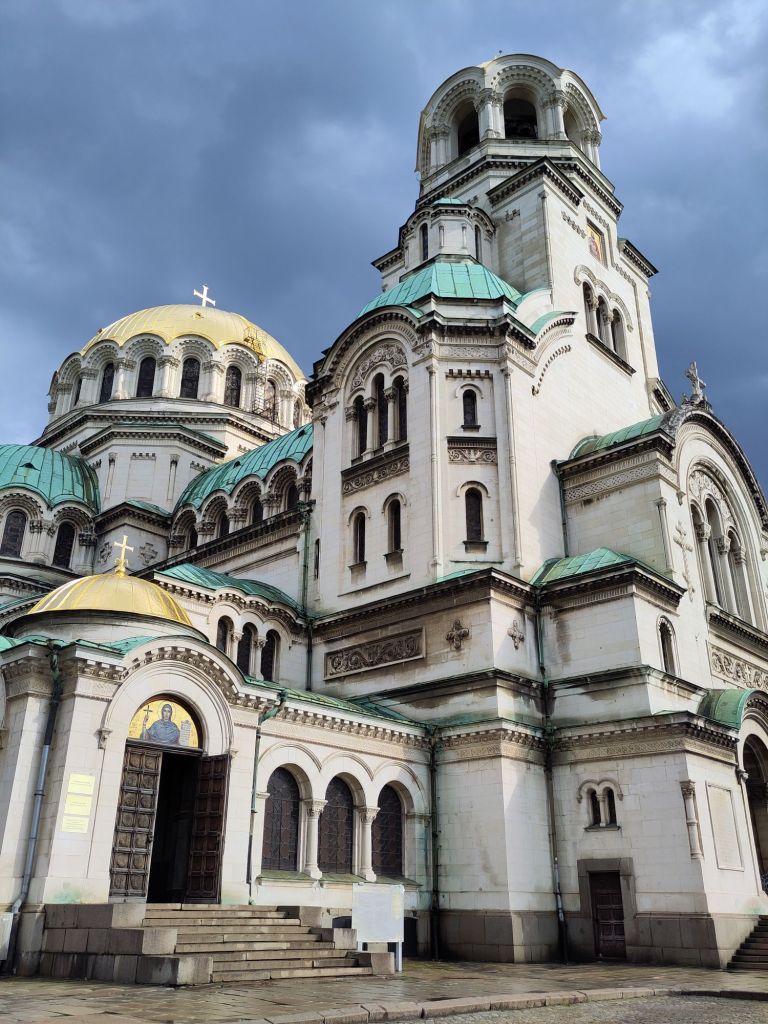
I did do a bit of looking around church buildings. One thing you pick up from the interpretative signage is that there’s a narrative of Bulgarian identity being tied up in getting rid of the Ottomans and being a Christian country. Which is something I found interesting and a bit awkward as to where the lines are — I’m a practicing Christian but from a tradition that diverged from the Orthodox Church a long long time ago, does that put me on the inside or very much on the outside? I mean obviously I’m not Bulgarian in many ways, but I definitely felt conscious of this particular aspect. And is the narrative on the signage reflective of people’s actual feelings about national identity, or is it a line being pushed by… the Church? The state?
The other interesting detail about the churches is that often the buildings are either suuuuper old or they date to the 1800s — a tour guide reckoned that before then, the Ottomans restricted the height of church buildings, and as soon as churches were allowed to be built taller many got knocked down and replaced with something showier.
Of course, more recently than the Ottomans, Bulgaria was ruled by the Communists, and there’s a neat (priced for foreign tourists) museum of life under Communism at ul. “Ivan Denkoglu” 24, the Red Flat. It’s an apartment which is still set up how it was in the 1980s, which you look around at your own pace with the help of an audio guide. I found it fascinating, sometimes funny, sometimes moving, and I learned a lot of little historical details like how the Black Sea coast in Bulgaria was a popular holiday destination for German families because it was open to tourists from both sides of the Iron Curtain, so families could meet up there who were otherwise separated by the Wall.

Practical details for future reference:
A bit of googling that first night in Sofia turned up this blog post from 2017, written by a Brit living in Bulgaria. It has a good number of recommendations for places to eat, drink and shop. Every one that I checked out was still there, and still good, in the space of “places where you can get away with not speaking Bulgarian but there’s no photo menus in sight”.
If you’re traveling by train, you can get to Sofia from Bucharest in a day (my experience or seat61.com instructions), or Istanbul overnight.
 Where's Zoe now?